Tuesday, 15 May 2012

Why we self-filter information...

Reading a post by Jeff Jarvis on lazy journalism and the easy target of new technology bringing the end of the world as we know it, I was inspired to add my tuppence-worth....

This is the issue that affects much of media.  Bias. It has been accepted for decades, if not centuries, that different newspapers will prefer different political parties and will skew the reporting to reflect that.  The paper one reads (if you still read dead trees) will usually reflect your political stance and how you vote - certainly in the UK.

Strangely there are still many who believe that editorials in traditional media are more worthy than blogs, which are ultimately editorials by unsponsored individuals. No less coherent or knowledgeable, necessarily. But by not having a behemoth organisation behind the writer, the opinions are for many less relevant.

And so it goes with new technology.  If one wants to believe Google is evil, one will self-filter news and articles to focus only on those that conform to one's world-view.  Ditto Apple.  Ditto Facebook. Ditto the internet. Mobile. Location...

It is frustrating, therefore, for those of us who 'get' technology, to see the myths being repeated time and again by lazy journalists.

I haven't self-filtered the various stories to focus on the Jeff Jarvis one that agrees with me, have I?! ...oh wait...

But heaven forbid that I should ever find a newspaper or site that agreed with me completely.... sometimes one needs naysayers and the small-minded in order to rant and vent....so long as everyone does rant and vent and does not simply accept the words of the sponsored without question...

This message has been sponsored by the Campaign for Ranting At the Press.

Wednesday, 25 April 2012

How does Google Drive controversy?

Having been a fan of Google's products for many years, with Gmail, Google Docs, Google Maps, Google Desktop (RIP), Android, Picasa, Google Scholar, Chrome, Google Books and Google Translate figuring prominently in my private use of technology (oh - and I use Blogger too) - not to mention the work use of Google Analytics and Google Adwords - I was looking forward to the long-awaited Google Drive - an online storage facility for all and any files so that I don't need to remember a USB stick or have my laptop to ensure I can get to any file anywhere.  I already pay around $5 a year to increase my storage on Gmail/Picasa etc. to 20GB.  Very reasonable I think....although I've noticed that this deal no longer exists and the nearest other option is to pay $2.49 per month (just under $30 per year) for 25GB.  I'm not happy about this...but it's not a huge burden on finances.

When I got an iPad from work, I discovered the joys of Dropbox and having all my documents sync'd on the work laptop, the home desktop and the iPad... but being very price-sensitive, chose the basic version (i.e. free) with a 2GB storage limit.  It forces one to clear out documents and folders every so often rather than continuing to accumulate files that will never be read again - which is no bad thing.

So with the launch of Google Drive announced yesterday I immediately thought that as soon as there is functionality built-in to the various iPad apps that currently link to Dropbox, I'll be able to switch to G-Drive.

But then, of course, the controversy starts with some people trying to show that Google is now 'evil' (in contrast to their motto 'Don't be evil') by combing their Ts&Cs, adding 2 and 2 together and getting 3.14159.   ZDNet, a site that is usually a reliable source of tech news, has an article entitled "How far does Google Drive's terms go in 'owning' your files?" by Zach Whittaker.  Zach tries to highlight a difference in the Ts&Cs for Google Drive which say:

Your Content in our Services: When you upload or otherwise submit content to our Services, you give Google (and those we work with) a worldwide licence to use, host, store, reproduce, modify, create derivative works (such as those resulting from translations, adaptations or other changes that we make so that your content works better with our Services), communicate, publish, publicly perform, publicly display and distribute such content.

What was missing from the article is the same line in the Ts&Cs that both Dropbox and Microsoft have, which says:
Some of our Services allow you to submit content. You retain ownership of any intellectual property rights that you hold in that content. In short, what belongs to you stays yours.
And of course the post is riddled with comments explaining the 'what's yours is yours' part with others saying that Google is the anti-christ, should be burnt on the circuit-boards of public opinion and wondering what Google would do with their data?

So, with no other information available other than my own common sense, I imagine that what Google wants to do is have the right to crawl our files to identify trends and gather data. They won't be 'reading' our files, but if they can identify x% of G-Drive users have Britney Spears photos, or y% have a last will and testament, that might be of use to the wider public.

There is another use, however. Google Translate works not by translating every word in turn like a first-year language student with a well-thumbed dictionary, but by comparing phrases and finding the same phrase on the internet with a translated version and making an assumption that the translated phrase will hopefully work as a translation for the new text also.  Surely, therefore, if Google suddenly has access to more data with which to mine such translations, the better?  Surely the ability to see how documents are written (by people who probably do not have a blog or a website) will help formulate semantic language generators for artificial intelligence?

In the same way that you should not leave sensitive data on a laptop, iPad or mobile phone without having a password block on the machine and encrypting the actual document (how many laptops, iPads and mobile phones are stolen every day, compared to successful hacks of online document repositories?) one should be careful about encrypting documents before storing them online.

But there is a big difference between actively reading my emails, documents and data, and allowing computer code to analyse it.  If it were not for Google's 'bots' identifying key terms in my emails, they would not be able to offer me a great email product for free subsidised by ads that I was able to quickly blank from my vision.  If it were not for my house being on Google View, I would not also be able to use the service to see other places that help me when driving or walking to an appointment.

Google hasn't sold its corporate soul to the devil.  I personally don't think they have abandoned the ethos of 'Don't be evil'.  But corporations, as with all organisations, are just like people.  And as Joe E Brown (right) said at the end of Some Like It Hot:  "Nobody's perfect!"


Wednesday, 21 March 2012

Using Social Media to Get a Job


As more means of communication become available, different managers in different organisations have varying degrees of familiarity and ability with those media.  In short, some are tech-savvy, some dream of the time of parchment and quill pens.  


Unfortunately, for the job seeker, this means you have to cover all the bases to try and get your CV and job application in front of the recruiter: including sending a CV and covering letter printed on quality paper (100gsm) in a large, hard-backed envelope, with the address printed and not hand-written.

Screenshot from LinkedIn profile
Fortunately, however, more and more managers are embracing new technologies and trying to find out as much about prospective employees as possible in the shortest time possible. They do this by using the internet and social media in particular.  So, tips for the job-seekers are:

  1. Google yourself.  See what sites the first 10 links refer to and what images come up.  Are they suitable? Are they the kinds of links you would like a future employer to see? If not, do what you can to change the websites listed or remove images that are less than flattering.
  2. Manage your settings in Facebook to ensure no embarrassing information is public. 
  3. If you intend to specialise in a specific area, build your personal brand by posting comments and opinions both through Twitter and by creating a blog.  On Twitter follow people interested in the same subject area. Find interesting news and information on the subject and retweet it. Connect to people when relevant.  Blog on the subject, particularly if you have several years experience and are able to share insights into the issues affecting your industry.  Remember to keep everything professional – you want a future employer to find it and rate you on the strength of the information posted – and you need to ensure others who see the blog (including former employers, co-workers or clients) will not take offence.
  4. Build your profile on LinkedIn. This involves putting as much information as possible on the platform as you would on a CV – giving employment history, skills, responsibilities, achievements and so on.  List the university and post-graduate education... unless you’re very young, school information should not be relevant.  Ensure you have uploaded a photo and connect to all colleagues, former classmates, clients and other business contacts.  Get colleagues, former employers and clients to recommend you on LinkedIn. The more senior the person the better.
  5. Use LinkedIn and Twitter to connect to people in organisations that interest you.  If you see a vacancy in organisation ‘XYZ’ and a friend’s contact on LinkedIn works for ‘XYZ’, then ask your friend for an introduction through LinkedIn and, if granted, ask the contact, nicely, if they can give you any suggestions on how best to present yourself for the advertised role. What is the organisation looking for?  Who would you be working for?  Use social media as your future employer would and find out as much as possible about the organisation and the people you would be working for.  This will allow you to adapt your application and, hopefully, the interview, to show how you are a perfect fit with the company.


Tuesday, 21 February 2012

What is Glocial Media?


I started running sessions on Social Media and its impact on business in 2006.  I would often use the byline for the sessions “It is not just Facebook and Twitter…” which even today seem to be the only platforms large parts of the business world have heard of. Even some of the post-graduate students I teach now are still ‘offline’ when it comes to social media.  Some of the students, however, are far ahead of the curve and are harnessing social media to create new business ideas.

However, just as social media is another country to many people, social media in another country can be completely different.  Most English-speakers will think only of platforms from the USA when they think of social media… the ubiquitous  FacebookTwitter and YouTube.  Whilst those platforms do have international reach and dominate the global social media netscape, individual countries and regions often use them in different ways or have their own platforms that have proven far more popular with the native population.

Students from the Masters in Digital Marketing at Hult International Business School gave a presentation during Social Media Week in London at 01Zero-One in Soho, in the heart of London on just that.  The presentation, entitled “Views from inside: Social Media from around the globe” gave a whistle-stop tour of ten countries and how social media has been used there.

Fernando Martinez (@fermart19) kicked off talking about Colombia and how Groupon enjoyed first-mover advantage for a year, at most, before two clones were produced by the large media organisations in Colombia who had direct and easy access to the local businesses.  He also explained how Colombia has a very high level of creative digital talent, to the extent that a lot of web design for the USA is outsourced there.  In summary, there is a lot of competition and with a young and tech-savvy population, only good products and services will survive there.

Staying in Latin America, Larissa Sabino Erbacher explained how Brazil, with over three times the population of the UK, uses social media as it behaves offline, to be friendly and communicative.  E-commerce and business networks are growing, but the vast majority of social media use is ‘traditional’ social networking through Orkut (Google’s first foray into social networking before Google+) which accounts for 60% of Orkut’s total traffic.

From Brazil, the talk took us to Germany where Jennifer Bahr (@jenny_bahr) over 35 million people are registered on social networks, with 96% of the 14-29 age group on a network.  Over the half of the German inhabitants are online and 90% of them belong to the group relevant for advertisement between 19-49.  Whilst Facebook and Twitter are the most popular platforms in Germany, three related networks appealing to different age-groups and are by invitation only: ‘SchülerVZ’ is for school kids, StudiVZ is for students and MeinVZ is for professionals.  Wer-kennt-wenn connects people by geography whilst if you want to do business in Germany, you cannot rely on LinkedIn alone: XING is the German equivalent to LinkedIn and is three times more popular.  With over 22% of Germans accessing the internet on a mobile phone, it is little wonder that ad-spend for mobile has doubled at the same time as TV advertising has fallen.

It is hardly surprising that Germany, the richest country in Europe, uses social media differently to Greece… hanging on to solvency by its fiscal fingertips.  Ioanna Koliou (@IoannaKoliou) explained Greece doesn’t really have local social networks apart from zoo.gr, with 33% of the population on Facebook and LinkedIn seeing a surge in popularity thanks to the growing unemployment rate.  A key role of social networks in Greece, however, is for protest.  The “Bring them Back”  campaign aims to apply pressure on the British Museum to have the Elgin Marbles returned to their home, not helped by the recent theft by armed robbers of ancient artefacts from Greek museums).  The online campaign incorporated a YouTube video that went viral in Greece.  The global economic crisis has hit Greece harder than most and Facebook is being used to organise protests against the austerity measures and, to those who are tired of Greece’s image on the global stage, Peter Economides  has tried to ‘Rebrand Greece’  using social media.

Moving across the Mediterranean, Africa is the 2nd most connected region by mobile subscriptions and Egypt has the second largest internet usage in Africa.... (Nigeria is the first).  Yasmeen Marie (@Yasmeen_Marie) showed how social media in Egypt became an international issue when a Facebook group was set up to protest on 25 January which went viral. There was no specific intention to create a revolution, but when the government tried to stop the 25 Jan meetings, people got behind the movement, with over 2 million people at one of the protests in Tahrir Square.  When the authorities blocked internet access, Google and Twitter provided a service called ‘Speak-to-Tweet’ where users could call an international number and dictate a message. The messages would be tagged #egypt and were available to those in Egypt by dialling the same numbers or going to  twitter.com/speak2tweet.  An interesting example of how an online phenomenon was able to transfer offline to overcome censorship.

Russians” meanwhile “are the most engaged users of social media in the world, spending an average of 9.8 hours on social networks. This is almost double the global standard.”  Stacey Boguslavskaya (@Social_Net_Pro) explained, however, micro-blogging (such as Twitter) is not popular and Russians are not keen on location based services. The big winners in Russia are local social networks such as: vkontakte.ru and odnoklassniki.ru; perhaps partially due to the weather encouraging people to stay at home and connect online.  Russians prefer to use local platforms, so there is huge potential for entrepreneurs who can create Russian versions of Hootsuite, Tweetdeck, Yelp, Quora, Kickstarter or Pinterest. Finally, Russians have an average of 1.5 mobile phones, but only 11% of them are smartphones.

India, in contrast, has far lower mobile penetration with only 5% of the total  population. But with a population of 1.2 billion people, that equates to 61 million people or almost the entire UK population.  India is, according to Priyanka Ganguli (@priyaganguli) , a country where change is a constant.  What is popular today will be old hat tomorrow… Hi5 was the leading social network before giving up its place to Orkut. That in turn gave way to Facebook, but Twitter is now more popular.  What matters is how trendy the site or platform is and how connected it is – whether one’s own network has made the move or not.  Another issue to think about is how the government in India is implementing monitoring and censorship of social media.

From the biggest country in the world to one of the smallest, Angela Cheong (@angelacfw) explained how Singapore has a household broadband penetration of 104% and 70% of the 5.1 million population have smartphones – the highest in the world.  The smartphone is fundamental to accessing the internet in Singapore with mainstream Western sites such as Facebook, Blogspot, Twitter and LinkedIn dominating social media behaviour.  Corporate use, however, has not matched that of individuals, with only 30% of organisations using micro-blogs, 40% using social networks and 50% using video sharing – and when they use social media, they do not always understand how. An example shown by Angela was how SMRT, the main train company, failed to respond with information when a train was stuck underground with thousands of commuters on board, in the stifling darkness. The company ignored its Facebook account to feed information to the general public and only set up a Twitter account several days later after a series of further mechanical failures.  They tried to make a big deal of not fining a passenger who broke a window on the train to let in air – with a resulting public backlash to the mere suggestion that the passenger could be fined having a far worse effect on their public reputation.  A study has shown that local brands can achieve the same level of recognition as major brands like LV, Adidas and Gucci with a good social media strategy.

Taiwan could not, however, be more different to Singapore.  In Taiwan, Facebook penetration has grown by 7000% in Taiwan in the two years since a Chinese language version was launched – essential for any platform hoping to launch in Taiwan – but still tends to be the preserve of good looking young people who like posting photos of themselves.  Michelle Chen (Pin-Hsien Chen @pinshian) explained that ‘normal’ people tend to prefer the anonymity offered both through not needing to post photos nor use real names on Bulletin Board Systems (BBS).  The two largest BBS in Taiwan are PTT and PTT2 with 1.5 million registered users and around 10% of total internet users in Taiwan.  The boards focus on specific topics, such that there is even one on ‘gossip’ which is used by journalists as a pseudo Wikileaks. To show the importance of BBS in the minds of the Taiwanese, it is worth mentioning that they had a film, á la ‘The Social Network’:


Finally, the Philippines is not, as  Aaron Joshua Barroso (@mraaronjoshua) explained, just about eating dog, nurses and caregivers.  The event was nothing if not informative and I, for one, did not imagine the Philippines to have a population of 94 million people spread over 7000 islands.  The internet penetration is not that high at 30%, but there is an 80% reach of mobile phones and the country is the SMS leader with over 2 billion text messages sent every day – an average of 26 texts per person per day.  Most people going online to watch videos, blog and engage with global networks such as Facebook, Friendster and Multiply, but it does have home-grown clones such as PicLyf and Churp Churp for photo sharing and microblogging.

So what does this mean for the future of social media?  Facebook is all-dominant and there is no micro-blogging service to rival Twitter.  There are, however, still very large regional clones of the social networking platforms that are more popular – an important point to remember when trying to reach audiences in those regions.  Mobile is, as has been pointed out often, huge in some countries – meaning digital marketing must think of the platform of distribution and not assume everyone will have a large computer screen to view the content.  Finally, social media is about people connecting with people – for socialising, dating, gaming, recruitment or revolution.  People will find a way to connect regardless of the channels. If the internet breaks, they will go mobile. If technology breaks, they will go back to offline methods. They will connect, however, and will look favourably on those that facilitate those connections.

And what is 'Glocial Media'?   A term I thought sums up the trichotomy of social media today: it must be global, local and social.   

Monday, 30 January 2012

What new marketers need to know

Following a request from a colleague, I thought I'd turn this into a post.  Five questions (with my answers) aimed at newly graduated marketers:

  1. How did you discover the world of Online Marketing?
  2. I was an expert in music before finding gainful employment in the internet and was recruited as Director of Content & E-Commerce to a start-up selling CDs and other music-related products online. They needed someone who knew their ABBA from their Zappa and could segment music lovers from medieval madrigals through to garage and grime.  My role naturally included all non-music related content and marketing too and expanded to include all areas of digital.  The slow death of the music industry helped me decide to focus more on digital in the future than music.

  3. What are 3 common mistakes that marketers make?
    1. They forget who the competition is.  Marketers often only focus on the brand competitors, and ignore the other things that compete for the customer’s attention and wallet.

    2. They forget who the customer is and what they want. Marketers often focus on showing how great their brand is and how different and special it is compared to the rest – when in many cases the customer simply wants something reliable and to know they have made a sensible purchase.  This all comes down, clearly, to buyer behaviours and psychographic segmentation.

    3. They forget about the marketing mix (on a basic level, Product, Place, Promotion, Price) and focus only on the Promotion or advertising side.   Zara is an example of a highly successful global brand that has had minimal advertising, but has been extremely effective using other elements of the mix, by paying a premium for core locations of their stores, competitive pricing and ensuring the client base know that their products are fashionable and also only available for a limited time before a new collection arrives.


  4. What advice would you give to young marketers after they graduate?
  5. Image: Stuart Miles / FreeDigitalPhotos.net
    1. Don’t set your sights too high at the beginning;
    2. Get experience in as wide a variety of roles and jobs as you can; and
    3. Only think about specialising after a few years.

    The reason for this is that if you start work in an agency you might find it very hard after a few years to get work on the ‘client side’ where the demands are different (you might have to do a lot more stakeholder management inside the organisation).  

    Equally, if you are only ‘client side’ within an organisation, you might find it very hard to make the jump to agency.  Equally, if your role is more offline or broadcast media, then you might find it difficult to convince a future (or existing) employer that you are also capable at the digital side, and vice versa.  

    The analytical side of SEO, PPC and so on can be less attractive to some than, for example, being on the creative side. But having those analytical skills is essential and will grow in importance as more data becomes available through the use of mobile devices by larger sections of the population.

  6. Google has recently introduced a new social media platform, Google+. Do you think that one day it can take over Facebook and Twitter?
  7. Can it? Yes. Could it? Yes. Will it? No idea. Remember that 5 years ago MySpace was the all dominant social network, and 5 years before that it was sites like ‘Friendster’ or ‘Friends Reunited’.  It looks like Facebook has achieved now a global domination that makes it harder for  others to overtake, but there are still more people not using the platform than are.

    And many people choose not to have a social life on social networks and only use them for business connections or as productivity tools. So there is still scope for someone (it might be Google, it might not) to produce a platform that adequately deals with all those other uses.  All the social networks are currently limited and, for me, frustrating. Twitter, equally, is a very limited tool and there is no reason why another tool cannot topple it.  

    Remember in the 90s Yahoo! was all-dominant, everyone had a Hotmail account and there were dozens of search engines available that people would use according nothing more than aesthetics (they all worked equally badly).  Any firm that thinks it is unbeatable is setting itself up for a big fall.


  8. Do you believe that Facebook’s $100B IPO is setting a precedent among all the social media competitors? 
Is it setting a precedent where the social media competitors believe now that the market is ready to understand they have a future?

Yes.

Is it setting a precedent where good business models in the social media world can have successful IPOs?

Yes.

Is it suggesting that all social media organisations are worth tens of billions?

No. Like everything, it depends.  

Some large organisations might get equally high billing, but it all comes down, unsurprisingly, to the business model.  How do they make their money? If they rely on advertising (as Facebook does) is there enough revenue to sustain it? Is it profitable now? Is it likely to be profitable?

There are companies that have great ideas, as many did in the dot-com boom of the nineties, that haven’t properly thought about how to make a business out of the idea.  Any organisation that successfully bridges that gap should feel confident about being able to have a successful IPO… but it is unlikely that they will get close to Facebook’s evaluation.

Wednesday, 28 December 2011

How to understand online marketing in an instant

Having several courses to teach next year on Digital Marketing, I'm in two minds as to whether or not I like the inforgraphic from unbounce.com as:
  1. it makes my life so much easier... being able to give students the infographic and telling them to get on with it; whilst also
  2. realising that this might make my role teaching digital marketing somewhat redundant.

However, seeing as everything in life is futile and we are all merely passing time until the next change, I share the infographic below...


The Noob Guide to Online Marketing - Infographic


Thursday, 22 December 2011

BloMob: the future of digital publishing

One of the most frequent excuses I hear from clients, students and colleagues when we are discussing blogging and the use of digital publishing tools to encourage sharing and collaboration, is "I don't have time to blog".

One of the reasons I think Twitter is so popular is because the format is so limited that people feel less pressure when posting and can publish ideas without expanding on them.

The problem is that Twitter is limiting as well as limited...and there are many ideas and comments that cannot legitimately nor legibly be reduced to 140 characters.

The growth of tablets like the iPad has probably helped people create content on the go....although it's not easy to type on most tablets while on the move.

Recording thoughts like a personal podcast is possible on a variety of platforms like AudioBoo, but the disadvantage of audio is not being able to skim-listen, unless you are partially sighted and used to absorbing audio information really really quickly.

So what is the future?

There are two sides:
a. It has to be mobile, clearly, to allow people to develop posts on the go.  But that's not ideal as this post can attest....being written through an app on a train....creating links and embedding images is fiddly to say the least...
b. dictablog: being able to dictate thoughts into a mobile or other device and hoping it correctly transcribes the dictation into text. It would also need to become clever enough to insert links and images... and you have the downside of having to speak loudly and clearly into your mobile, possibly in public, definitely looking like a fool.

So what alternative is there?

Simple....keep your thoughts to yourself....           

Wednesday, 14 December 2011

Automating value judgements

In my role as a professor of marketing and technology, I fully expect to have to assess and grade students. That is part of the lot of a teacher of any kind, from kindergarten onwards (although, arguably, the assessment may take different forms over the years).

As a conscientious educator, I am keen to ensure all the hard work of the students is also fairly and fully assessed.  There are possibly those, as rumour and legend would have it, who throw their papers down the stairs and then start grading those on the top step as 'A's, those on the 2nd step as 'B's and so on down to 'F's on the bottom step.

Tempting though it might be, I am determined to be as paperless as possible.  So far I have saved at least 700 sheets of paper in just one course (assuming double-sided printing) through not printing the submitted assignments.  And throwing a laptop or iPad down the stairs to achieve the same effect just wouldn't do. Think of the splinters.

However, grading 2000+ word assignments is time consuming.  If you do it properly, it involves reading each assignment at least twice, possibly more. Comparing papers to ensure the comparative grades in the class are fair.  Composing specific feedback (100 words minimum? 200 words optimal?) to help the student understand their grade and improve for the future.

Group work needs assessment and, by the nature of group work, involves fewer actual papers to read and assess. But it removes the individual assessment and is therefore subject to slacker students benefiting from the hard work of other team members.

There is no getting past it.  Detailed, objective and rigorous individual assessment is essential.  But how to do it efficiently?

My first thought was to build the most advanced AI computer in the world and get it to grade the computers.  As soon as the patent comes through I'll let you know.

My second thought was back to throwing everything down the stairs.

My third thought was carrying on as I have been and grading at 2am until I get through them all.

So my final thought seems the only viable option, other than me pulling an 'all nighter' or 7.  If Amazon, and every e-commerce site worth its salt, can tap into the crowd to assess and vote on how good (or not) individual books are, surely that would work for individual assignments from students?

All one would need would be a simple website, such as Scribd, where the PDF documents of assignments could sit, visible to the world.  The world at large could then read the assignments and grade them. Once a critical mass of assessment is reached (such as 500 votes), the average is taken as the final grade.  Space for comments would provide the feedback.

This is, in fact, I am certain, genius. There are only two obstacles to overcome:

  1. Getting that critical mass of people to read and vote on all the assignments in a short timespan; and
  2. Ensuring the students and their families do not vote for them.
If, therefore, you ever see such a business model come into existence, remember you read it here first.  Until then, it looks like I have an 'all-nighter' ahead of me....


Top image: digitalart / FreeDigitalPhotos.net

Friday, 25 November 2011

The Art of Innovation

Guy Kawasaki's presentation on 'The Art of Innovation' is worth recommending not just for the anecdotes, insider view, venture capital experience and pithy rules to innovate, but also for showing how to present to a conference.

Humour. A good sense of humour is good. If you don't have it, don't try and fake it, but if you have it, flaunt it....

This keynote was from 2007 - but having only just discovered it 4 years later I thought it worth passing on...


Wednesday, 16 November 2011

The only way is up...unless you drill down...

This post is a copy and paste from a brief summary of the state-of-the-nation I had to produce today, giving a summary of the global economic climate at the moment.


As 2011 draws to a close, three years after the start of the current financial crisis, there is no indication of the situation improving. The OECD says all economies it monitors suffered a downturn in September with the U.S., Japan and Russia returning to their long-term trend (with the U.S. achieving 2.5% growth) but the UK, France, Germany, Italy, Canada, Brazil, China, India and the Euro area falling below.  It predicted the G7 countries would grow by just 0.2% while Germany, the world’s second largest exporter, falling by 1.4% in the Q4.
Within the Eurozone, the Greek economy contracted by 5.2% in Q3, an improvement on 8.3% in Q1 but still painful. Portugal, the previous danger area for bailouts, shrank by just 1.7%, Ireland and Italy were stagnant and Spain rose by 0.8%, compared with the UK’s 0.5%  growth.  Lithuania and Estonia, by contrast, rose by 7.8% and 7.9% respectively.

After days of speculation about Italy and Spain needing a bailout with Italian bond yields exceeding the 7% threshold beyond which it is believed they could not pay back the loans, and Spanish bond yields rising, both countries have seen the bonds bounce back after the European Central Bank has agreed to buy the country’s debts.  However, confidence in Italy’s economy is still shaky as yields rose once again shortly afterwards.  The focus on Italy remains high as it accounts for 16.8% of Eurozone GDP compared to Greece’s 2.3%.

The domestic problems in those two countries, however, have forced the resignation of Greece’s Prime Minister Papandreou and Italy’s Prime Minister Berlusconi have led to a new era of technocrats with academic economists Lucas Papademos, a former VP of the ECB in Frankfurt, and Mario Monti, a former European Commissioner, taking the reins respectively, providing a warning to politicians in charge of all failing economies that their successors could be civil servants, not fellow politicians.

UK inflation has fallen slightly to 5% from a ten-year high of 5.2% thanks mainly to current supermarket price wars, whilst clothing, electricity and gas prices continue to rise.  By comparison, prices in the Eurozone held steady at 3%, whilst the US rate of inflation fell slightly to 3.5%.


Finally, Britain has helped the love-hate relationship between Angela Merkel and Nicolas Sarkozy by giving it something to join together and fight against: David Cameron and a proposed Tobin Tax on financial transactions which the Tory leader is adamantly opposing.

All this, of course, is good news.  Whilst the present outlook is bleak, it means that things can only get better. 


A brief look at today's FTSE 100 index, showing the past 10 years, shows how things go up, and then they go down. Sometimes they go very down, but they tend to go up over time.


FTSE 100 Index


So here is hoping that the global economy is going to follow that trend....now just to cross those fingers and toes...

Wednesday, 9 November 2011

How to put out a Flash in the pan...

Twitter has been loud this morning talking of Adobe killing off its fancy animation language 'Flash' for mobile devices.  The news first came, it seems, on ZDNet whilst the Adobe website still talks about creating Flash for mobile devices, but then Adobe wouldn't be the first company that failed to tell its web team what it had told the rest of the world.

Some commentators have been remarking, probably rightly, that Steve Jobs has finally won, beyond the grave, in his war against Adobe.  It was in April last year that the Apple anti-Flash venom started spitting.  Mashable ran a series of emails between Steve Jobs and an Adobe developer that suggested Jobs' hatred of Flash was purely about the stability of the platform and the ability of Apple to be able to lock in both app developers and iPhone and iPad users by making it harder to create the same app for multiple platforms (Android, Windows, RIM etc.).

The 'Roughly Drafted Magazine' blog ran an article just after the Mashable one that gives a nice summary of the real background to the Apple-Adobe spat.  In short, it has nothing to do with Flash. It has nothing to do with whether or not Flash is unstable or not.  It clearly has nothing to do with delivering a great user experience, as most websites had some element of Flash when the iPad first appeared (not to mention the iPhone before it) which could not be viewed by Apple users.

So if Adobe won't support Flash for mobile devices, surely it cannot be long before Flash dies out? HTML 5 will take over completely once Internet Explorer adopts HTML 5 with version 9, (despite many users still on I.E. 6, such as corporate clients too frightened to update anything once they have locked it down enough to make it secure) and no website will be developed using Flash.

So what is the fall-out to this?  Flash developers had better start retraining and fast. Flash trainers had better start teaching something else.  Accessibility experts had better start charging for something else as they won't be able to spend hours pointing out how un-accessible Flash is.

And pages will load faster...(take note Burberry!)

And the world keeps turning...it just no longer uses Action Script...

Thursday, 3 November 2011

How do you know you have failed?

"99 percent of success is built on failure." -  Charles Kettering
I have recently heard much talk about how all good entrepreneurs have lived through failure and that, in fact, an entrepreneur needs to fail on the road to success.  The Guardian's Tech Weekly Podcast recently discussed this when talking about the new 'Silicon Roundabout' area of London rich in technology start-ups and why none have achieved comparable success with their 'Silicon Valley' counterparts.


Apparently the British don't tolerate failure the way those in the US do.

If one peruses the millions of words recently written about Steve Jobs, much is spoken about his products which failed, his personal failure in being sacked from Apple, and how he spoke in the (now famous) Stanford Commencement Speech about how he learned from those mistakes.

But no one seems to know how to answer one simple question:
How do you know you've failed?
There are hundreds, if not thousands of potential entrepreneurs worldwide who have great ideas.  Many of them put the ideas into practice and develop those ideas into a functioning product or service or artistic endeavour (such as a composition, an artwork or a novel).  Many of them are persistent in trying to get funding for their company or to get others to back their ideas both financially and morally.

Some are lucky. Through friends, family and serendipitous connections with investors and mentors, they are able to get their business off the ground. They might get a mention in the local press or even the national media. They might present at trade shows or speak at conferences.

But they do not achieve the critical mass necessary to make the business profitable.  Some investors are patient and, as with Amazon, will wait up to seven years before seeing even a modest profit; but many investors are less patient and will stop funding a start-up after a few years of operation.  Would Amazon have survived if it had taken two more years to move into the black?  Bill Gates said "Microsoft is always two years away from failure".

When should creatives, in business or the arts, decide to cut their losses and try a different direction?  Pulp, the Sheffield band, took sixteen years from forming to reaching national and international success.  In 2009, The Economist wrote how entrepreneurship was finally 'cool'.

So all the angel investors, VC funding, government grants and deregulation of start-up bureaucracy is great, but perhaps what is really needed is some objective guidance and advice for when someone should persist with their idea because their time will indeed come; and when they should just pack it in and try something different.  We could call them "Reality Checkers".

For those who do wish to persist, I recommend reading the quotes on innovation on ideachampions.com.

Perhaps the best quote for me, however, is by Douglas Adams:

"A learning experience is one of those things that says, 'You know that thing you just did? Don't do that.'"


Wednesday, 19 October 2011

An atheist's view of Steve Jobs

It was two weeks ago today that the world started an outpouring of comment on Steve Jobs and his sad death. As it is sad whenever anyone dies... a bit of a tautology that is repeated by every media outlet whenever anyone famous dies of any cause at any time in their life.

Apple's website is still, two weeks after his death, showing the memorial photo any time you visit the website.  A day of memorial one would expect.  A week might be appropriate for the founder and CEO of your company.  But how long will it now stay up? Will it be dropped, unceremoniously, without notification, after three weeks? Or a month? Or will they keep it there for a year?  What is the appropriate amount of time to grieve for someone you didn't know at all, except through the vicarious the spotlight of celebrity?


Candles outside the Apple Store, London

The outpouring of emotion, such as flowers and candles laid outside the Apple store in London, echoed the sudden quivering of the traditionally British stiff upper lip and ultimate breakdown of the previously stoic public into a collective, sobbing, emotional wreck, when Princess Diana (or Mrs Diana Windsor, as some might prefer it) sadly died (see the flowers below).

Flowers outside Kensington Palace
Then, as now, I find myself wondering why people care so much.  Surely, it is because the person (Jobs, Diana) was famous? That people felt that they knew them? Or was it that they found the death of a celebrity a useful catharsis for them to release pent-up emotion for some other, more private, loss?

I am not a psychologist and shall not attempt to understand it, suffice to say that I don't.

However, another phenomenon seems to have occurred around the death of Jobs.  Stories of him being a bully and a tyrant have finally seen more widespread coverage since his death, which allows one to reasonably address the fact that far from being the best CEO in the world, his is a case study that should be used in business schools to show how a great leader should not behave.

An apparently obsessive care for the detail of products makes a great product designer, not a great boss.  A culture at an organisation where people fear the CEO does not make for the best working environment.

When Jim Collins studied exceptional leaders and came up with the concept of a 'Level 5' leader who enabled great change at an organisation that survived a change of leadership and continued to make the organisation highly successful, he  described parable of the fox (which knows many small things) and the hedgehog (which knows one big thing).  Jobs was probably a hedgehog - he knew how to make great products and charge customers a premium for them.

Ansoff's Growth Matrix
When discussing technology innovation on the masters courses, Apple is frequently  cited as an example of an organisation with a great growth strategy - for product development and diversification - creating new products for existing markets and creating new markets (as per Ansoff's Matrix shown here).

Through the use of iTunes, Apple have also managed to ensure casual customers become loyal customers (achieving market penetration).

It is also worth remembering how much Apple's stock has risen recently, from an average of $7 to $10 for most of its life to 2004, to a current $420 - showing how much the iPhone and iPads have radically changed Apple's revenue structure.

Apple stock from 2000 to 2011 from Yahoo! Finance
So it can be safely stated that Steve Jobs was a great CEO in delivering value to the shareholders and creating products that became market leaders for several years after launch.

Image by Edward Eustace
But that is it.  The deification of Steve Jobs is somewhat unnecessary.  I realise that posting a blog about him is perpetuating the impression that he is the only person of worth who has died.  His inventions certainly changed the technological landscape by influencing how Microsoft developed Windows (the OS that most people still use) and how mobile technology can become ubiquitous.  Interesting to note, by the by, how Microsoft make no mention of Apple's use of the WIMP interface (Windows, Icons, Menu, Pointing device) in their own potted history of Windows.

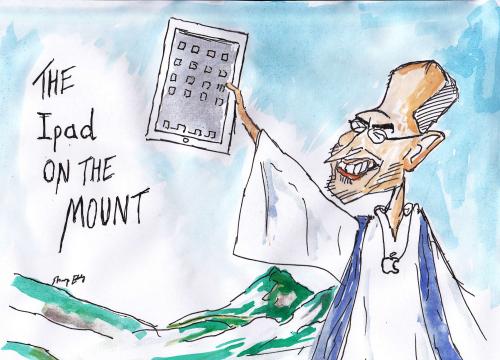
The BBC documentary in May 2011 showed through MRI scans how "Apple was actually stimulating the same parts of the brain as religious imagery does in people of faith".  The theory (by Dean Hamer) that there is a gene which predisposes people to being religious or having 'spiritual experiences' helps explain my own perplexed view of the Apple faithful (or iCult as it has been dubbed).

So if Hamer is right, I am genetically predisposed to treat all evangelicalism with suspicion...be it for Apple, football, or one of the many gods.

The Church of Apple has many devotees - and a higher than average percentage of them work in the media - helping fuel the constant messages of Apple omnipresence.

But in the end, us atheists must pray, with ironic tongue firmly in cheek, that sense will see the day, reason will out, the blind shall have their veils lifted and that everyone shall see that there is no god. There is only:


Thursday, 22 September 2011

5 ways to gamify trade fairs and expos

Attending the Ad:Tech exhibition at Olympia in London yesterday and today, I am struck by how untechnical it is. No suggestion of participating online. No suggestion of accessing information online as one moves about (an ideal Layar layer would surely be information on the stands and products on your smartphone as you move about the show floor). No suggestion of moving towards a virtual fair...which is surely the future...but when? I am also struck that between seminars, which can be divided into two groups: those that make an effort to tell you something new and those that don't attempt to hide the fact that they are here to sell their products and services, the show floor can be a little boring if you are not specifically looking for a new supplier of universal analytics or mobile widgets.

So here are some ways to gamify your trade fair experience:

1. At a fair like Ad:Tech, which combines marketing and technical elements, there is a fun game of "spot the techie". The techies who go to this fair are more socially aware than many of their backroom cousins, but still tend to dress differently from your core advertising people. That's not a bad thing. The world needs people who keep servers running and set up websites and provide analytics software. But you can, if you wish, divide your targets along a spectrum from 'Too cool for school' through to 'Übergeek and borderline Asbergers'.

2. Related to this, is spot the brands who do not realise this is the 21st century and there is no place for sexism. They are easy to spot. They have young women dressed in skimpy clothing with the company brand on their chest giving out leaflets and other freebies. If they had men in skimpy clothing that would not improve the issue....we're at a business trade fair, not a disco.

3. Freebies. This is fun. Go around the fair to pick up the best freebies you can. So far I have an aluminium water bottle, a book, a beach ball, a squishy Einstein and a desk-basketball set. No need to buy Christmas presents this year!

4. If you are not trying to watch your weight as I am (well, watch it not changing and wishing it would go away), see if you can get a free lunch from the diffent sandwiches and canapés on offer at the different stands. You could try and get drunk too....there are occasional offers of cheap champagne and wine.

5. Create your own version of X Factor. At the seminars, score the presenters on their performance. You could have different criteria, such as appearance, vocal style, PowerPoint slide quality, audience interaction.... You could even give em feedback, such as "Enthusiastic delivery John but you are in danger of sounding like you are hectoring the audience and borderline irritating" or "Great content Jane but think about how you can use your voice to keep the audience awake".

In fact, this suggests to me a great new idea for a start-up. We will create an app for all mobile platforms (iOS, Android, RIM, Windows) that for any given trade show will provide a list of seminar speakers and exhibitors. The exhibition organiser could use the app to share schedules with attendees, but the game part will be to have easy one-touch buttons to score speakers on different criteria, a sliding scale from übercool to übergeek which you can use to rate speakers and attendees, a 'name and shame' feature to spot shameless sexism by different exhibitors. You could even award badges such as "Runner-up best speaker" or "Too cool for school" to individuals. You could earn points too according to freebies and food consumed.

We could showcase the app at next year's Ad:Tech. We just need to get the chocolate teapots to give away, branded miniskirts, sock-and-sandal combinations for sales staff, and we'll need to take a course on presentation skills. If anyone wants in, just let me know. This time next year we'll be millionaires....


Tuesday, 20 September 2011

HTC Sucks - and not in a good way

Having been a fan of Android phones in principle since they came out (the open nature of Android, the viable alternative to iOS and the Apple fanfest, the particular liking of Google's way of doing things as opposed to how Apple or MicroSoft do things) I have been traumatised by my experiences with my first Android phone.

Money being an object for most people like me, I could not go and buy the Google Nexus S (a Samsung phone) but haggled with my mobile company (Three) to get a £10 per month SIM card with all-you-can-eat data, 750 minutes of talking, 150 texts and a few other things.  I then bought a mobile separately working out that over 2 years I would save almost £200, as opposed to paying a monthly contract of £25 or more.  I bought the HTC Desire (the precursor to the HTC Desire S and HD versions) as a friend had one and had had no problems with it and I saw good reviews on the internet.

The friend in question doesn't use apps.

I've uninstalled all apps except for Google's own apps and a couple more, and yet am still in danger of running out of internal phone storage space. Again. After 8 factory resets trying to remedy the matter.

Yesterday, three apps (Goggles, Maps and Evernote) automatically updated themselves and the remaining internal memory went down from 44MB to 22MB in an instant and then trickled down to 15MB with me doing nothing on the machine!

HTC only made 150MB of internal memory available for apps. So even though I move all my apps to the external storage (the SD card), they still leave residual memory on the internal storage that eats away until there is nothing left.

When the memory slips below 15MB, Gmail and Exchange stop updating.

HTC have, eventually, offered to repair the mobile, and I might ask them to just to make sure there is no fault with the hardware. But I fear the fault is with the design.

For the first time ever I'm jealous of iPhone users who have no issues with app space running out.

What this has taught me is two things:

a. avoid HTC like the plague: there is a reason their handsets are cheaper...although TechRadar does list 3 of them in the top 10 Android phones, and 3 in the top 5... irritatingly...
b. look for internal storage for apps when buying a smartphone.  I have never, however, seen this listed on the product specifications online or instore.  You have to dig deep to find it...but it is worth digging.
c. if you want a recommendation for any hardware from a friend, make sure the friend is a similar user to you. If they are a light user, then it won't help a heavy user judge performance.

Yes...that is 3 things...but anyway...

All of this is, of course, obvious. But the obvious only presents itself sometimes too late...